
CSE Faculties Receive Best Paper Awards at ECIR 2026 and IC3IT 2026
The Computer Science and Engineering (CSE) Department at Qatar University proudly celebrates two major research achievements by its faculty members at the international stage. Dr. Mucahid Kutlu and Dr. Cagatay Catal have each received Best Paper Awards at international conferences—European Conference on Information Retrieval 2026 and International Conference on Innovative and Intelligent Information Technologies 2026—highlighting the department’s strong contributions to impactful and innovative research in Artificial Intelligence and Information Retrieval.
Dr. Mucahid Kutlu received the Best “IR for Good” Paper Award at ECIR 2026 for his paper titled “Measuring Political Stance and Consistency in Large Language Models.” The research reflects strong undergraduate engagement, with contributions from CSE undergraduate students Salah Feras Alali and Mohammad Nashat Maasfeh. The research is in collaboration with Dr. Saban Kardas from the Gulf Studies Center at Qatar University.

The research investigates how large language models express political stances across major global issues, including the Israel–Palestinian conflict, the Russia–Ukraine war, and China’s policies toward Uyghur Turks. It further examines the consistency of these stances under different prompting strategies. The findings reveal that, in many cases, models adopt identifiable positions rather than remaining neutral, and that these positions often persist despite attempts to influence responses through prompting. The study highlights the critical importance of digital literacy and encourages users to approach AI-generated content—particularly on sensitive political topics—with caution and critical awareness. This work was supported by the Qatar National Research Fund under UREP grant (UREP 32-0301-250278).
In another remarkable achievement, Dr. Cagatay Catal received the Best Paper Award at IC3IT 2026, held in Hammamet, Tunisia (26–28 March 2026), for his paper titled “Artificial Intelligence for Algorithm Discovery: A Three-Dimensional Framework.”
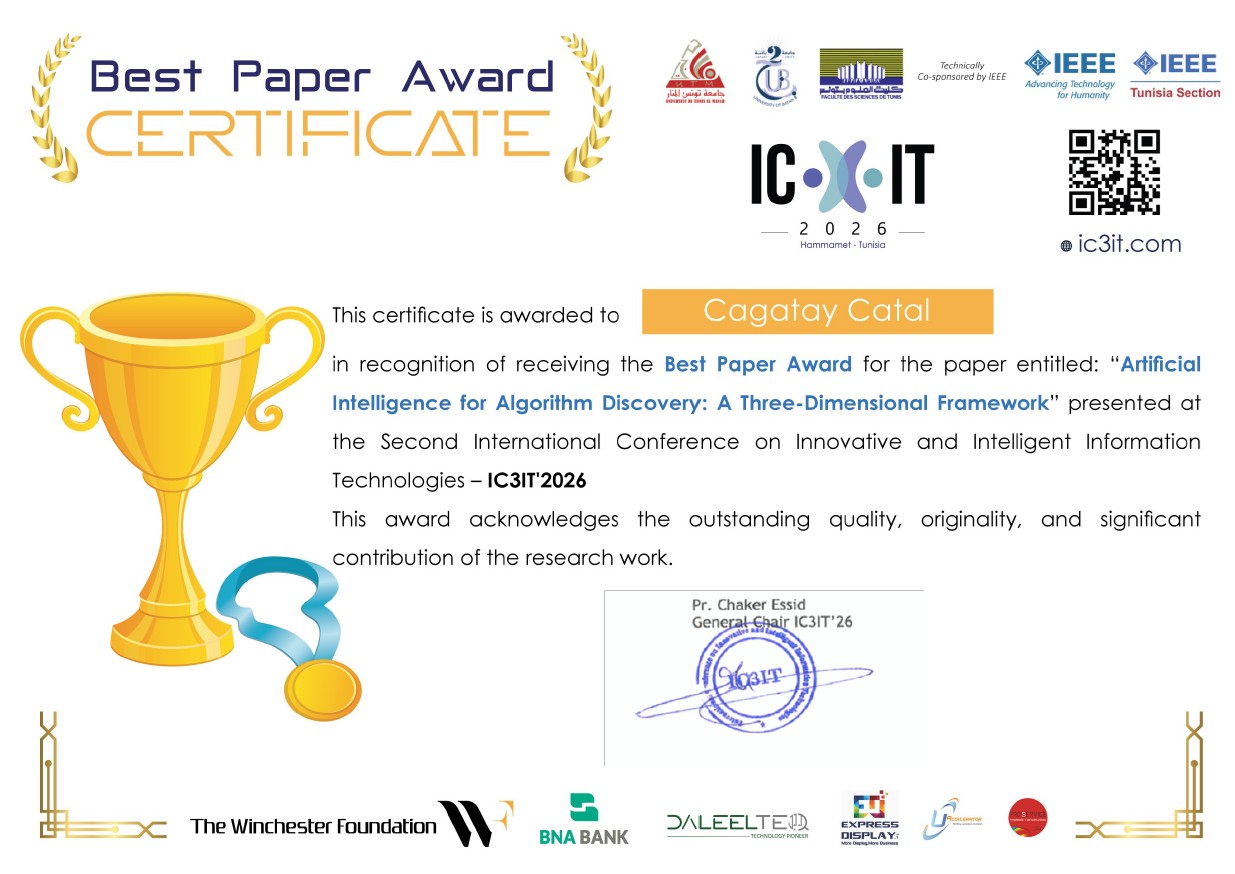
The paper explores a transformative direction in Computer Science, where Artificial Intelligence is leveraged to automatically discover algorithms—moving beyond traditional design paradigms such as divide-and-conquer, dynamic programming, greedy methods, backtracking, and branch-and-bound. By integrating advances in Deep Reinforcement Learning and Large Language Models, the study proposes a novel three-dimensional framework that connects problem domains, discovery techniques, and optimization objectives.
The research also includes a case study demonstrating how the framework can systematically classify AI-based algorithm discovery systems and clarify their contributions. This work is closely linked to an ongoing QRDI-funded research project at Qatar University focused on AI-based smart aquaponics systems. In this context, algorithm discovery is expected to play a key role in enhancing multi-objective optimization, adaptive system control, and resource efficiency—supporting innovative solutions for food security and sustainable agriculture.
These achievements reflect the CSE Department’s continued commitment to advancing research excellence, fostering innovation, and addressing real-world challenges through cutting-edge technologies.