Home » Achievements » Research

Category Archives: Research

Categories

CSE Faculties Receive Grants on Institutional Collaboration between Qatar University & Khalifa University

CSE department is pleased to announce that Dr. Khaled Shaban and Dr. Osama Halabi have received awards under the Institutional Collaboration Grant (Qatar UniversityKhalifa University) 2026 cycle. The awards recognize impactful collaborative research that addresses critical challenges in energy systems and sustainability.
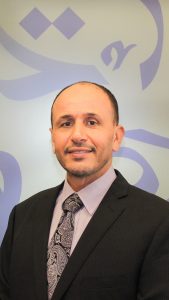
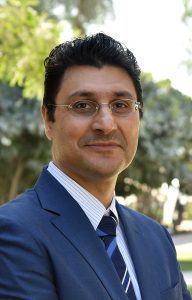
Prof. Khaled Shaban

The first awarded project, led by Prof. Khaled Shaban, is titled “Optimal Energy Management Framework for Inverter-based Interconnected Microgrids with 100% Renewable Penetration.” The project responds to the growing global shift toward renewable energy integration and the rapid expansion of electric vehicles and charging infrastructure—developments that are reshaping how modern power systems are designed and operated.

The research aims to develop a scalable and intelligent energy management framework for inverter-based, interconnected microgrids operating with full renewable penetration. The proposed solution will optimize the allocation of grid-forming and grid-following inverter-based resources across multiple microgrids, while coordinating localized control strategies at the system level to ensure reliable, efficient, and resilient operation.

Project Team

Qatar University (QU)

  • Principal Investigator: Khaled Shaban, Computer Science and Engineering

  • Co-Investigators: Ahmed Massoud, Electrical Engineering, Nuri Onat, Qatar Transportation and Traffic Safety Center

Khalifa University (KU)

  • Principal Investigator: Tarek Hussein Elfouly, Electrical Engineering

  • Co-Investigator: Surour Mohamed Alaraifi, Electrical Engineering
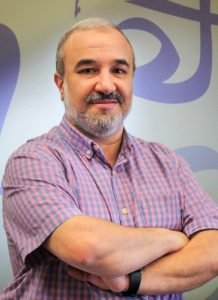
Dr. Osama Halabi

The other project is led by Dr. Osama Halabi and supports a cutting-edge robotics initiative titled “Visual-Haptics for Remote Robot Operation, Inspection & Physical Intervention.” This two-year collaborative project between Khalifa University and Qatar University aims to advance remote robotic operation in challenging environments such as underwater infrastructure and greenhouse agriculture. The research focuses on transitioning a visual-haptic teleoperation framework from laboratory prototype to real-world validation (TRL 4–6).

The project integrates multimodal visual and haptic feedback, predictive safety control, and immersive XR interfaces to enable safe, intuitive, and resilient human-in-the-loop robot operation. By addressing the limitations of visual-only teleoperation and unreliable autonomy, the work paves the way for more robust robotic inspection and physical intervention systems.

Project Team

Qatar University (QU)

  • Lead Principal Investigator: Osama Halabi

  • Principal Investigators: Mohammad Abdulaziz Al-Sada, Faisal Ibrahim J J Al-Jaber

Khalifa University (KU)

  • Lead Principal Investigator: Jorge Manuel Miranda Dias

  • Principal Investigators: Hamad Karki, Jaime Viegas

This project brings together an interdisciplinary team with expertise in robotics, artificial intelligence, haptics, extended reality (XR), and human–robot interaction, representing a significant advancement in cross-domain teleoperation research within the region.

This award highlights the strength of cross-institutional collaboration between Qatar University and Khalifa University and underscores their shared commitment to advancing sustainable energy technologies and intelligent power system solutions.
CSE faculty receives research funding from Google

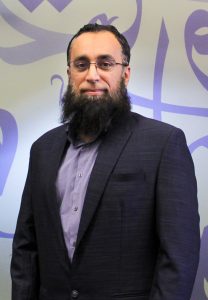
Prof. Tamer Elsayed

Dr. Tamer Elsayed, professor of Computer Science at our department, has just received a research funding of 100k USD from Google to support his research work on Arabic language technologies. The award letter states that the award is “part of Google’s growing effort to support excellent research in academia”.

The department values this recognition from a key industrial partner like Google, which also reflects the excellence and impact of Dr. Tamer’s research in advancing Arabic language technologies.

Congratulations once again to Dr. Tamer and his research team, and best wishes for continued success and fruitful high-impact outcomes in shaa’ Allah.

CSE Faculty Secures QRDI Grant Award for AI-Integrated Islamically-Grounded Psychotherapy

Prof. Junaid Qadir, a faculty member of our CSE department, and his interdisciplinary team have secured a $300,000 research grant over 24 months from the Qatar Research, Development, and Innovation Council (QRDI). Awarded under the “Advancing Neuro and Mental Health Research” (ANMR) Call, this project highlights the team’s pioneering leadership at the intersection of technology, faith, and mental health.

Prof. Junaid Qadir

The funded initiative, titled “Integrating Generative AI with Traditional Islamically Integrated Psychotherapy (TIIP) for Religious OCD”, brings together experts from across institutions and disciplines. The project is led by Prof. Qadir (Qatar University) alongside Dr. Hooman Keshavarzi (Hamad Bin Khalifa University), Dr. Alaa Ali Abd-Alrazaq (Weill Cornell Medicine—Qatar), and Dr. Syed Ibrahim Ghaznavi (Information Technology University, Pakistan).

The research addresses scrupulosity, a form of religious obsessive-compulsive disorder (OCD). This condition manifests in intrusive doubts, compulsive rituals such as repeated purification or obsessive prayer, and deep feelings of guilt over perceived sins. To respond to this challenge, the project will design a mobile and web platform anchored by a Generative AI–powered chatbot. The chatbot, carefully fine-tuned under the supervision of TIIP experts, will deliver timely, Islamically-authentic therapeutic support while maintaining strict privacy and ethical safeguards.

By blending TIIP, behavioral science, and responsible Generative AI, the project introduces a culturally grounded and scalable model for addressing religious OCD in Muslim-majority societies. Crucially, the approach keeps human connection at its core while using AI to enhance personalization, engagement, and accessibility for those in need.

This project not only sets a precedent for integrating cutting-edge AI with culturally authentic psychotherapy, but also signals a new frontier in mental health care that is both innovative and deeply rooted in tradition.

Congratulations to Prof. Junaid and his team!

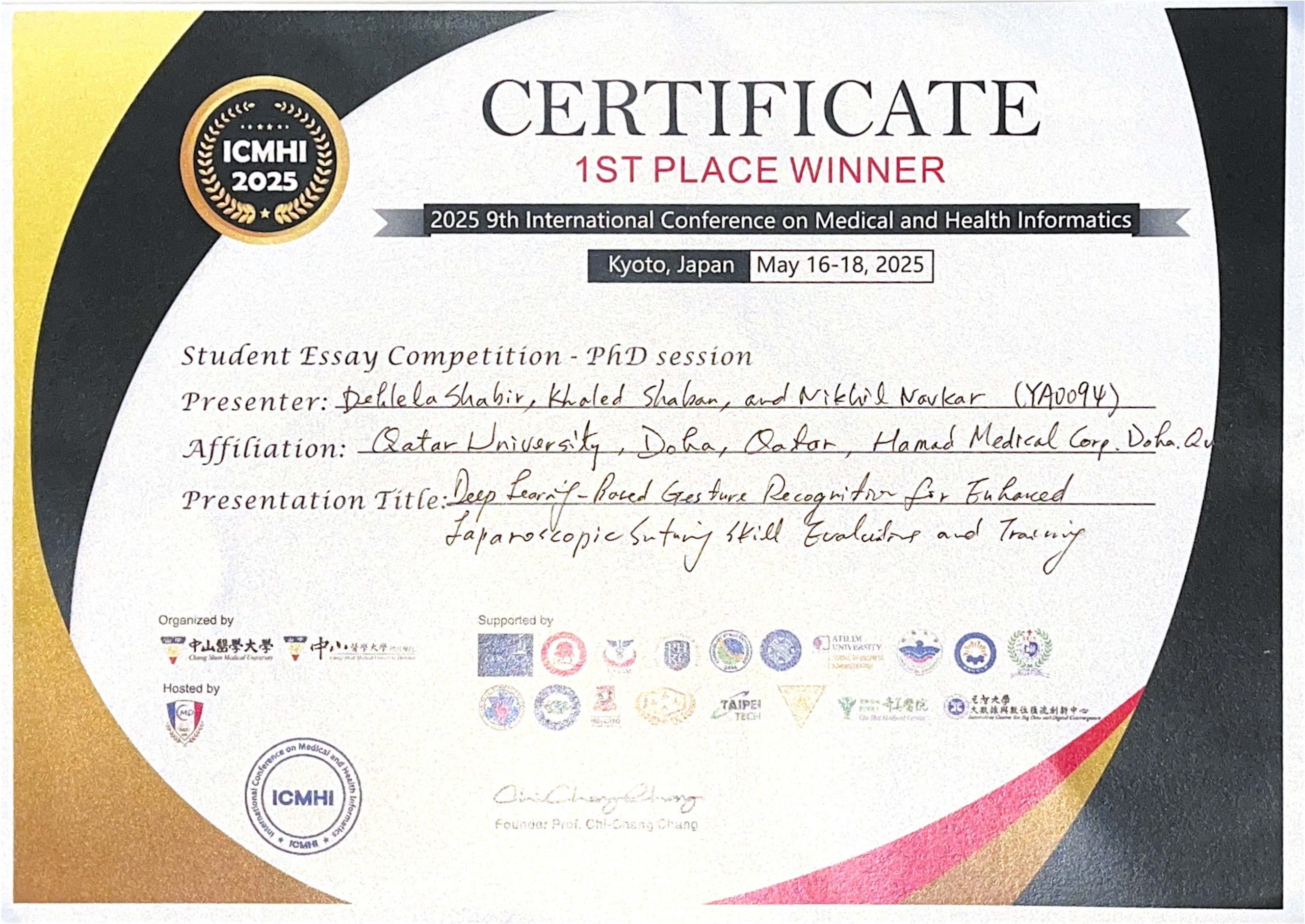
CSE PhD Student and Team Win First Place at ICMHI 2025 for Surgical Gesture Recognition Research

Dehlela Shabir, a PhD student at the CSE, Prof. Khaled Shaban, and Dr. Nikhil Navkar from Hamad Medical Corporation (HMC) have been awarded the first place in the student essay competition – PhD session, for their paper titled “Deep Learning-Based Gesture Recognition for Enhanced Laparoscopic Suturing Skill Evaluation and Training” at the 9th International Conference on Medical and Health Informatics (ICMHI 2025), held in Kyoto, Japan, from May 16-18, 2025.

ICMHI is an international platform for scientists, engineers, and technologists to showcase innovations in medical and health informatics, with topics ranging from biomedical data mining and medical image processing to cloud computing and personalized treatment. The paper is part of an ARG-awarded project, developed in collaboration with the Department of Surgery at HMC. The project focuses on improving skill acquisition in laparoscopic surgeries through automated gesture recognition using deep learning.

The team is working on several tasks aimed at advancing automation in surgical education and practice, including robotic minimally invasive surgery, mixed reality training, and the emerging concept of a surgical metaverse.

CSE PhD Student and Team Win First Place at ICMHI 2025 for Surgical Gesture Recognition Research

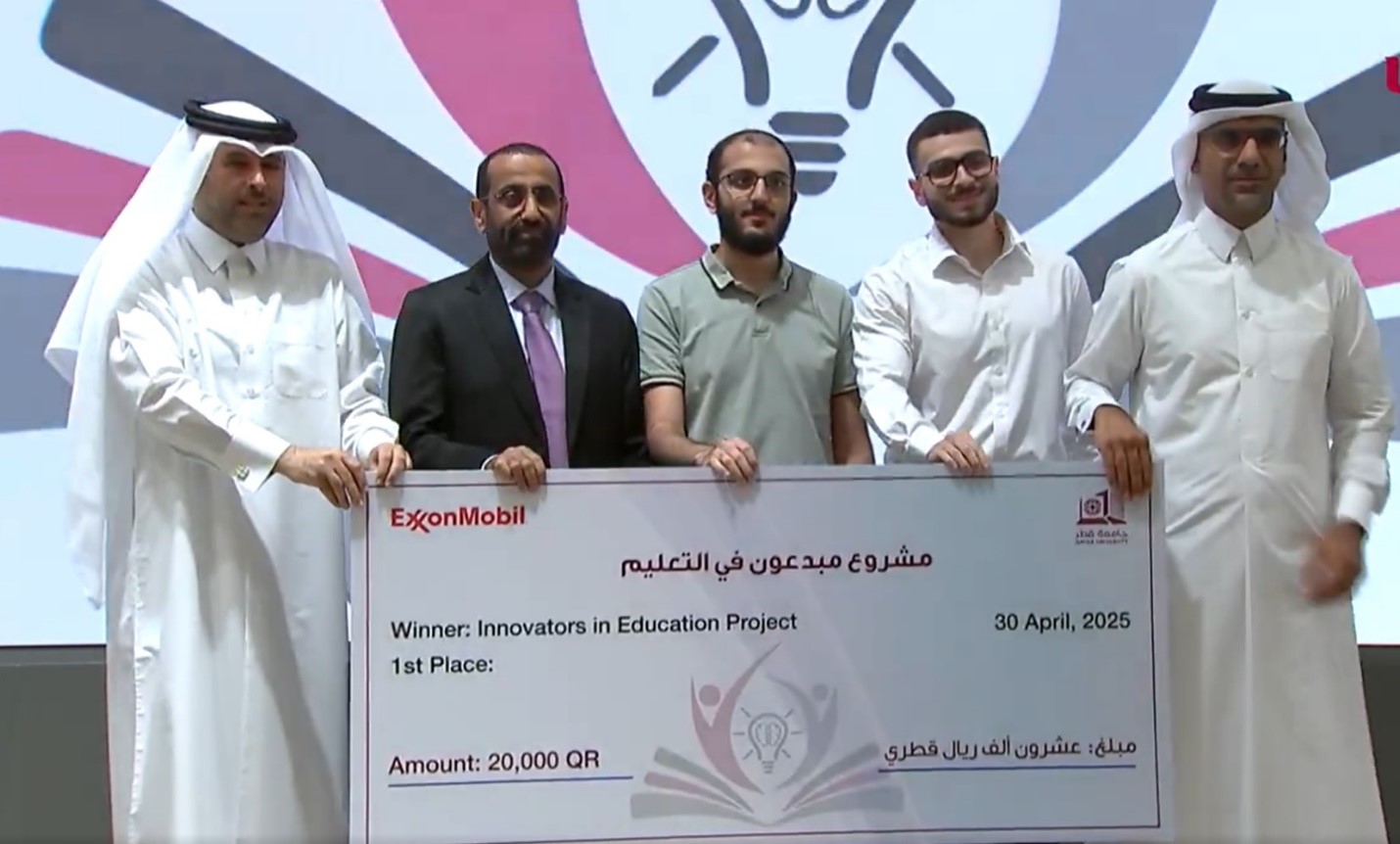
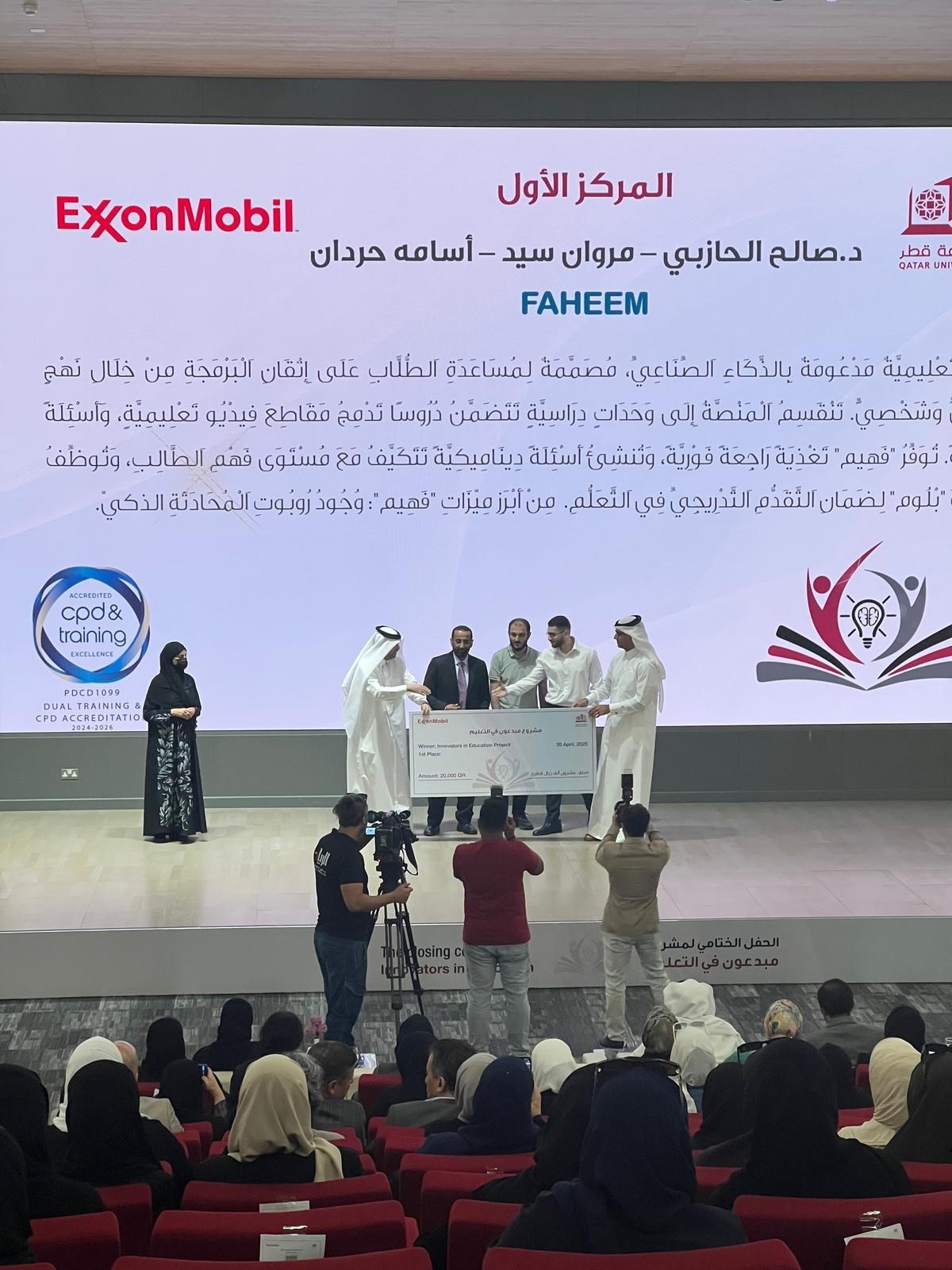
CSE Team Shines at Innovators in Education with AI-Powered Project “Faheem”

A team from the Department of Computer Science and Engineering earned the first place at the “Innovators in Education” event, organized by the College of Education in partnership with the Colleges of Engineering and Business at Qatar University, and proudly sponsored by ExxonMobil.

The award-winning team, comprising Dr. Saleh Alhazbi and senior students Marwan Sayed and Osama Hardan, presented their groundbreaking project titled “Faheem: An AI-Powered Platform to Learn Coding.”

Faheem is a smart educational platform that transforms the way students learn programming by offering an engaging and personalized experience. It includes concise instructional videos, automatically generated quizzes, and an AI-powered chatbot that interacts with learners in natural language. The platform also provides hands-on coding exercises, step-by-step guidance, performance evaluation, and adaptive feedback tailored to each student’s level—creating a fully immersive and individualized learning journey.

Warm congratulations to the team on this remarkable accomplishment!

A team from the Department of Computer Science and Engineering won first place at the “Innovators in Education” event

CSE faculty gives a keynote speech on AI applications in the Oil and Gas industry

Prof. Khaled Shaban participated as a keynote speaker and panelist in a workshop titled “Decarbonization and Energy Transition in the Oil and Gas Industry,” organized by the Gas Processing Center at Qatar University on Sunday, December 1, 2024. The workshop provided a vital platform to discuss the transformative role of advanced technologies in addressing the industry’s most pressing challenges.

Prof. Shaban delivered a keynote presentation on “AI and ML: Catalysts for Digital Transformation in the Oil and Gas Industry,” highlighting how artificial intelligence and machine learning are revolutionizing operations by driving efficiency, sustainability, and innovation. The presentation offered valuable insights into key applications, such as autonomous drilling, predictive maintenance, and supply chain optimization, along with actionable strategies to address challenges like data quality issues and resistance to change.

Prof. Khalid Shaban

Following the keynote, Prof. Shaban contributed as a panelist, engaging with industry leaders and academics to explore collaborative approaches for implementing AI/ML technologies. The discussions emphasized their potential to enhance operational agility and environmental compliance. His participation underscores a strong commitment to fostering innovation and shaping the future of energy through cutting-edge research and practical solutions.