
Home » Achievements » Department (Page 2)
Category Archives: Department
CSE faculties awarded with Internal Grants (2024, Cycle 7)
Five of our faculty members (Dr. Noora Fetais, Dr. Abdelaziz Bouras, Dr. Mahmoud Barhamgi, Dr.Khaled Shaban, and Dr. Elias Yacoub) and their research teams have just been been awarded QU internal grants 2024 (Cycle 7) in the different categories. Congratulations!
Here are more details about the winning projects:
Award Category: Collaborative grants (CG)

Project title: Practical Adversarial Machine Learning for Network Intrusion Detection Systems
Project team: LPI: Dr. Noora Fetais (QU), PIs: Dr. Khaled Khan (QU), Dr. Armstrong Nhlabatsi (QU), Consultant: Dr. Dan Dongseong Kim (University of Queensland)
Project abstract:
An adversarial example exploits an imperceptible attribute of the input to cause a deep-learning (DL) algorithm to misclassify. Attackers intentionally design these adversarial examples to confuse the model so that it makes a mistake. Some researchers hypothesize that adversarial examples are caused by highly abstract representations, which make the decision function extremely discontinuous. In contrast, others claim that adversarial examples occur due to the locally linear nature of neural networks. As a result of adversarial examples, researchers are developing countermeasures to defend against adversarial attacks against DL-based applications, especially in security-critical domains such as Network Intrusion Detection Systems (NIDS). However, the security of NIDS under adversarial attacks has not been well explored. The aim of this research is to enhance the understanding of practical adversarial attacks on NIDS. Here, a “practical” adversarial attack means the output of the attack is a set of replayable network packets, and adversarial attacks specifically refer to evasion attacks that slightly modify the input to bypass detection. To achieve these goals, this research proposal seeks to:
- Develop an adversarial attack generator tailored for NIDS and present a comprehensive evaluation framework to determine the severity of the attack on the NIDS.
- Propose a defense mechanism to defend against adversarial attacks and formulate another evaluation framework to examine the strength of the defense.
The proposed project is expected to bridge previously identified limitations in adversarial NIDS attacks/defenses. To enable automation and deployment of future attacks/defenses, software toolbox/frameworks will be designed and developed. More importantly, the resulting framework, methods, techniques, and tools of this project are expected to be readily applicable in real world settings.
Award Category: Collaboration Co-Fund (IRCC) Grants
Project title: MESledger: A decentralized intelligent control of production systems based on AI and Blockchain technologies.

Project team: LPI: Dr. Abdelaziz Bouras (QU), PIs: Dr. Khaled Benfriha and Améziane Aoussat (ENSAM Institute of technology, Paris-France). Dr. Abdelhak Belhi (JBJADS, Qatar). Dr. Mahmoud Barhamgi and Dr. Loay Ismael Sabry (QU)
Project Abstract: The project focuses on the development of a new system for the intelligent control of digitalized production systems. Indeed, the old production control systems, based essentially on automats (Programable Logical Controllers), are not adapted to the new manufacturing processes, said digitalized. Such new system will be confronted with a mass of data generated by the IoT layer and the various IT systems required for operation.
It becomes important to think about a new “manufacturing execution system” able to analyze the data, to order dynamically the operations and to take the adequate decisions in front of malfunctions. Moreover, such system will be able to optimize production operations according to priorities, such as cost, energy or production time. To do this, it would be necessary to review the design of a manufacturing operation, known as standard and parametric. Thus, the system should be intelligent enough to configure the values of the parameters according to the priorities.
The industrial stakes are high. Companies will not be able to reach the expected performances without the intelligent exploitation of the generated data. From a scientific point of view, the challenge is to develop intelligent and scalable algorithms that can drive a digital production system with a high level of autonomy.
Project title: Building Transparent, Fair and Privacy-preserving Smart City Applications
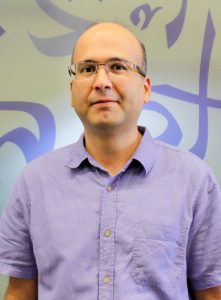
Project team: LPI: Dr. Mahmoud Barhamgi (QU), PIs: Dr. Saeed Salem, Dr. Qutaibah m. Malluhi, Dr. Noora Fetais (QU), Dr. Daniela Grigory (Paris-Dauhine University, France), Dr. David Camacho (Madrid University, Spain)
Project abstract: In Qatar, as well as in all advanced countries, Intelligent Cyber-Physical Systems (ICPSs) are increasingly becoming an integral part of people’s life. Their applications are exploited today to optimize many aspects of our daily lives including in healthcare (e.g., remote patient monitoring networks), smart food supply chains, smart road infrastructures (e.g. for efficient real-time regulation of traffic), and smart grids (e.g., for greener energy consumption). All of these applications are collectively called smart city applications.
They collect huge amounts of data about us, process and exploit them to make important decisions that affect our lives both positively or negatively. As these smart systems and applications are expected to grow and stay with us, it is important to ensure they are designed and operationalized in a way to respect the fundamental rights of their users.
In this project, we focus on how three fundamental rights of users including Transparency, Fairness, and Privacy can be ensured in ICPSs. Specifically, we propose models, mechanisms and software tools allowing the users of such systems to monitor how and why a decision affecting them was taken by the system, based on what data as well as how fairly they have been treated by the system compared to their peers or other groups of users. The provided justifications are computed by our solution while respecting the privacy of all users or data subjects impacted by the system. We intend to apply and validate our solution in two specific smart city applications including smart patient monitoring and traffic optimization.
Project title: DeIN: A Drone-based Inspection System for Outdoor Insulators in Qatar.

Project team: LPI: Dr. Khaled Shaban (QU), PIs: Dr. Saeed Salem (QU), Dr. Ayman El-Hag (University of Waterloo)
Project abstract: This research proposal aims to enhance the effectiveness of inspection systems for outdoor, high voltage insulators utilized in the electric power transmission networks of Qatar, the Gulf region, and beyond. The proposed research is significant due to the criticality of outdoor insulators in supporting and insulating overhead power lines (OHPL) and the impact of their poor electrical performance on the resilience of the entire transmission network. Insulators are subjected to harsh environmental factors such as hot and humid weather, heavy dust and sand depositions, and salt buildup, leading to accelerated aging and increased maintenance costs. Insulators are responsible for over 70% of power line outages and require continuous monitoring to prevent premature failures. While traditional inspection methods are expensive, time-intensive, and laborious, aerial-based robots, such as drones, equipped with sensors and advanced algorithms offer a promising solution. However, the data obtained from drones is susceptible to noise and uncertainties, affecting their accuracy and limiting their inspection capabilities. The proposed solution, DeIN, aims to develop a novel drone-based inspection system that combines vision and radiation-based sensors with state-of-the-art representation learning, fusion, and deep learning (DL) algorithms. DeIN offers advantages such as reduced inspection time and cost, increased personnel safety, enhanced precision, repeatability, and improved access to OHPL, eliminating user subjectivity. Moreover, the use of radiation-based sensors provides enhanced inspection capabilities for detecting surface cracks and internal voids, complementing the vision-based sensors. The proposed research contributes to the development of a reliable and efficient inspection system for high voltage insulators in Qatar, the Gulf region, and beyond, ensuring the reliability and security of power transmission infrastructure.
Award Category: CD-IRCC Sustainable Development Goals (SDGs)/Local Projects)
Project title: Wearable Bracelet and Machine Learning for Remote Diagnosis and Pandemic Infection Detection.
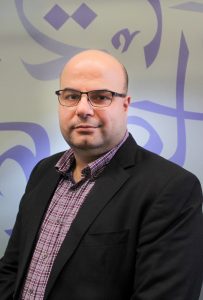
Project team: LPI: Prof. Elias Yaacoub (QU), PIs: Dr. Ahmed Badawy and Dr. Khalid Abualsaud (QU)
Project abstract: More than three years into the coronavirus disease 2019 (COVID-19) pandemic, it can be noted that the measures put in place for societies to manage the spread of this disease could have been better. For example, contact tracing mobile applications used to curb the spread of COVID-19 need additional enhancements to allow health care professionals to better understand the proliferation of the disease and to lessen the burden on hospitals and medical centers. In this project, we present an intelligent solution to remotely self-monitor COVID-19 symptoms to help rapidly identify and detect suspected positives. The proposed intelligent solution is based on using a near-field communications (NFC) wristband that collects body temperature, heart rate and SpO2 levels. It is connected to a dedicated mobile application to intelligently draw conclusions from the data (COVID-19 symptoms) it collects. Moreover, the application is trained to analyze cough sounds and detect the probability of infection. Current results show more than 90% of detection accuracy. The work in the project aims to deliver a prototype at TRL 5 or 6, where the bracelet with embedded sensors will be fully functional and the readings are sent to the mobile application, where they can be jointly analyzed with coughing sounds to further enhance performance. The proposed system can be adapted to future pandemics based on respiratory symptoms.
CSE receives Three QRNF Academic Research Grants (ARG)
Our CSE department has just been awarded three Academic Research Grants (ARG) from the Qatar National Research Fund (QNRF) in its inaugural round. The three awarded projects are led by Prof. Amr Mohamed, Prof. Somaya Almaadeed, and Dr. Ahmed Badawy.
Here are more details about the awarded projects:
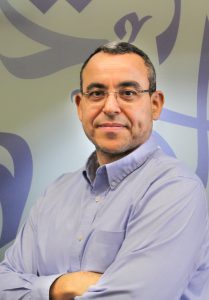
The PervasiveAeroAgents platform’s primary objectives are designed to address important challenges facing disaster scenarios, including 1) establishing the system architecture and describing coordinated multi-drone features such as sensing specifications, wireless charging, intelligent detection algorithms, and autonomous navigation. 2) Developing AI-based computer vision techniques using machine learning, to detect and identify objects and individuals among the debris, while using Reinforcement learning (RL) and online learning (OL) techniques for autonomous navigation, speeding up search and rescue operations in stochastic and highly changing environments. 3) Developing new security protocols suitable for dynamic ad hoc group communications amongst the drones to guarantee integrity and confidentiality. Finally, 4) build a comprehensive proof-of-concept using digital twin technology to demonstrate system features and insure the efficacy of the proposed sensing and AI-based techniques for group ad hoc communication.

Project abstract: Cancer, which has been identified as a significant public health issue in Qatar and worldwide, can be diagnosed early and accurately with the help of biomedical imaging. It is true that there has been a significant increase in cases of breast, thyroid, colon, prostate, lung, and stomach cancer over the past five years [1]. For instance, Qatar has one of the highest rates of female breast cancer incidence and mortality when compared to the other Middle Eastern regions. In Qatar, the latest Qatar National Cancer Registry (QNCR) report of 2020 revealed that breast cancer had the highest incidence among all types of cancers. It accounted for 37% of all cancer cases, with 218 new cases reported. Colorectal cancer ranked second among female cancers, comprising 10.7% of cases with 62 reported instances. Thyroid cancer held the third position, representing 7.2% of female cancer cases with 42 reported cases [2]. Due to a variety of factors, including lifestyle choices, environmental effects, and other factors, there are an increasing number of cases of breast cancer in Qatar and the surrounding nations. Imaging and biomedical imaging techniques, such as histology image [3], and/or positron emission mammography (PEM) for breast cancer screening [4], are frequently used by caregivers to accurately detect the spread of cancer in the human body. To locate, segment, and categorize malignant tumors, these biomedical imaging approaches rely on image processing and Artificial Intelligence (AI) [4]. Both AI and computational imaging and analytics for cancer detection layer of these imaging approaches are not sufficient to provide accurate diagnose of cancer and doctors do not understand the science behind the result. Therefore, we need a much smarter way to explain and hence link the results to the clinical data. Together with medical doctors in Qatar and UAE we aim to develop new tools and techniques for multimodal breast tumor classification based on integrative data analysis from imaging and clinical data including histopathological and OMICs. We aim to develop explainable AI tools to outline how the AI produced a certain result. AI can be used as a support system that scans image and process corresponding clinical data by extracting the areas, features, or data with a high probability of cancer to simplify a doctor’s job and provide additional hints for medical care and competence. Furthermore, this proposal aims to decipher the molecular pathogenesis of breast cancer using artificial intelligence through integration of histopathological images and OMICs data from different breast cancer subtypes. Multimodal data fusion of morphology, gene expression, and DNA mutations using IHC and OMICs technology has yet to be explored in depth. Implementing this approach using AI and Deep Learning (DL) can lead to a more accurate diagnosis of the disease and timely treatment. This will improve their overall survival and decrease the economic burden of breast cancer.
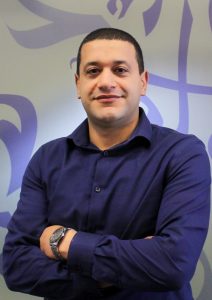
Project abstract: The Open Radio Access Network (O-RAN) is on track to completely transform the telecommunications ecosystem in the coming decade. O-RAN specifications are expected to drive 50% of RAN-based revenues by 2028 for public networks and by 2027 for enterprise and industrial cellular segments and will exceed traditional RAN by 2030. This research proposal aims to investigate and develop a reliable O-RAN framework for time-critical and high-resource-demanding healthcare applications.
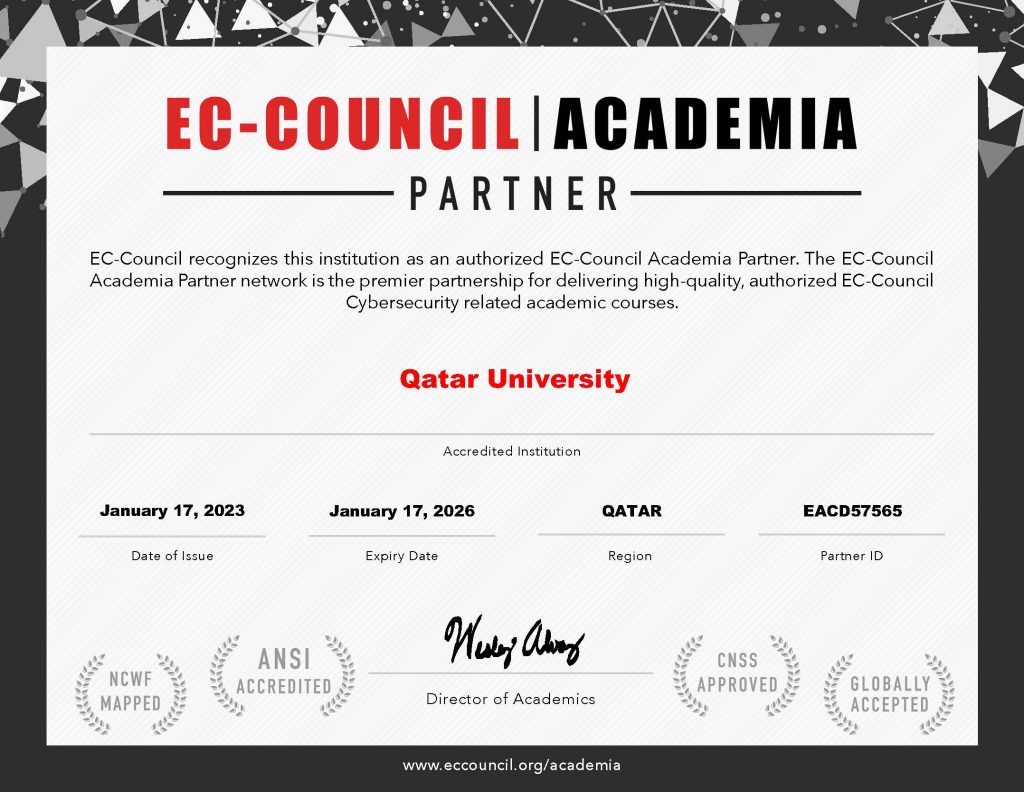
Academic Partnership with EC-Council


We are proud to announce our new academic partnership with EC-Council, the world’s largest cybersecurity technical certification body. This academia partner will benefit our CSE department in several directions including:
- Complimentary faculty certification scholarship in Network Defense, Ethical Hacking, and Digital Forensics.
- Complimentary evaluation resources for any faculty member to any EC-Council Academia Series course (including syllabus, eCourseware, instructor slides, and iLabs).
- Fully or partially integration of any EC-Council Academia Series course into our cybersecurity curriculum
- Discounts off Academia Partner rate exam vouchers for faculty members and students.
- Discounted courseware bundles and automatic exam eligibility for students.
- Access to the new EC-Council Essentials Series MOOCs.
- Privilege of becoming an EC-Council Testing Center (ETC) to administer EC-Council exams onsite
- Free Entry to global Cyber Security events such as annual Hacker Halted (https://www.hackerhalted.com/) and Global CyberLympics competition (https://www.cyberlympics.org/)
Looking forward to a successful partnership with EC-Council!
CSE Student Won in Huawei ICT Competition 2022
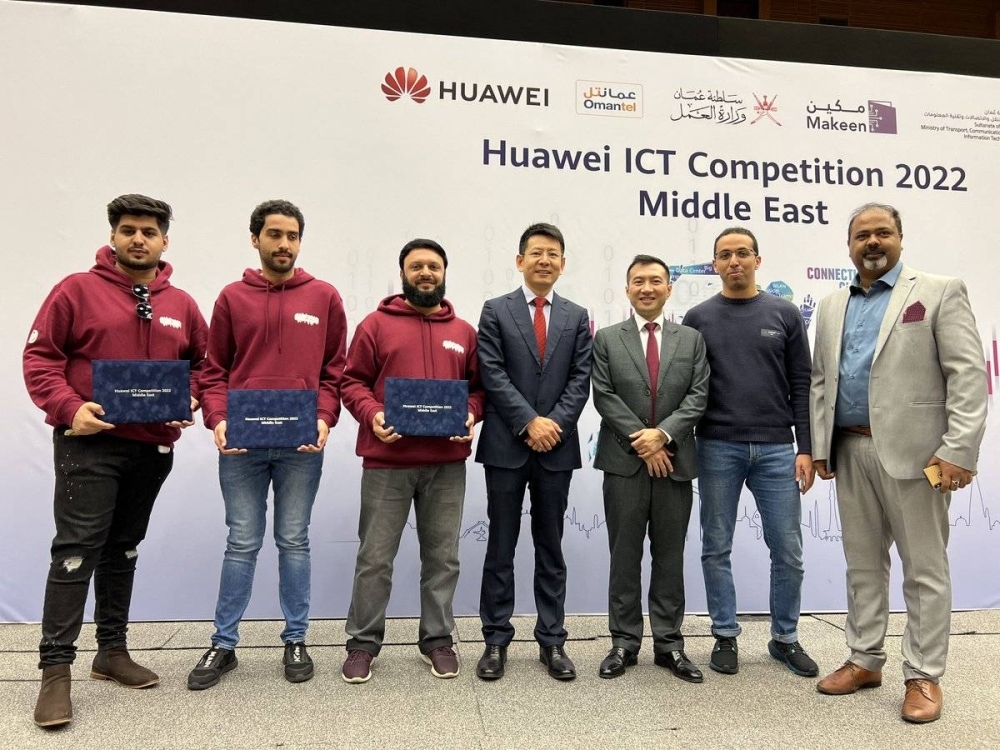
Congratulations to the Qatari team who managed to win the “Outstanding Performance Award” in the regional Final of the Huawei ICT competition (Middle East) that was held in Oman from 20th to 22nd of December. The team consists of three students: Hassan Khan from our CSE department at QU, and two other students from HBKU and CCQ
The Huawei ICT competition aimed at nurturing ICT talents to contribute towards preparing the next generation of ICT leaders for the digital economy. This year’s competition featured 15 teams representing 11 countries across the Middle East and Central Asia. A total of 45 students competed in the finals from an initial entry of 19,231 students from 472 universities and colleges across the region.
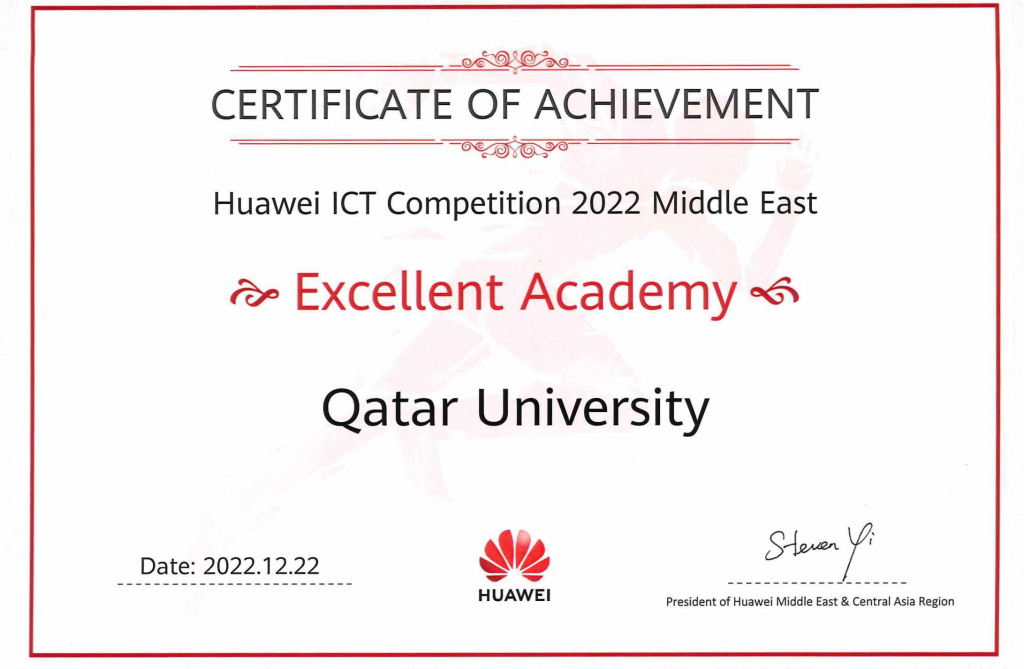
Additionally, Qatar University received the award of “Excellent Academy” due to the great operation of the ICT academy and the number and level of students who have been certified.
QU Ranked among Top 100 Universities Worldwide in Computer Science (THE 2023)
Qatar University has been ranked among the top 100 universities worldwide in Computer Science, according to Times Higher Education (THE) World University Ranking of 2023 that was just released. This is indeed a big achievement for our department. It is surely a result of years of active and hard work in planning, teaching, and research. Congratulations to all members!
QU’s rank has jumped this year over about 25 positions in THE CS subject ranking. With a steady progress over years, here are the CS ranks of QU since 2018:
- 2018: 251-300
- 2019: 201-250
- 2020: 201-250
- 2021: 101-125
- 2022: 101-125
- 2023: 95

Huawei Opens AI Lab at Qatar University

Qatar University (QU) has partnered with Huawei to open an AI Lab as part of the Huawei ICT Academy at the university. The collaboration is a further boost to Qatar’s economy, whose National Vision 2030 recognizes talent’s central role in forging a prosperous society.
The Lab was officially opened by Dr. Khalid Al Ali who delivered a keynote speech, as well as Dr. Khalid Naji, Dean of the College of Engineering, QU, and Liam Zhao, CEO, Huawei Gulf North, in the presence of other senior Huawei executives, dignitaries and faculty. The group later toured the state-of-the-art lab equipped with the latest technologies.
The Huawei ICT Academy Lab will train QU students using Huawei equipment to acquire high-level Huawei Certifications in a real environment. It will also support university research programs, provide cutting-edge technology and platforms, and inspire innovation by conducting industry and university collaborative projects and research.
Dr. Khalid Al Ali, assistant undersecretary for higher education in the Ministry of Education and Higher Education said, “We are highly encouraged to see our universities and the private sector coming together to advance education. We recognize that the public sector alone would struggle to meet the talent demand of the digital economy. But forging such partnerships elevate the skillsets of our youth and, in turn, helps build a competitive economy that can respond faster to market demand and global trends.”
Dr. Khalid Naji, Dean of the College of Engineering at QU, said, “As our country’s leading university, we are at the forefront of Qatar’s efforts to develop a highly-skilled labor force. Partnering with Huawei exposes our students to the latest advances in ICT while equipping them with real-world skills that meet the demands of a digital economy. We will continue to explore further areas of cooperation as demand for digital skills accelerates.”
Liam Zhao, CEO of Huawei Gulf North, said, “Huawei has a long-term and mutually beneficial relationship with the State of Qatar and various public and private organizations. The opening of the AI Lab deepens this relationship while helping the country deepen its ICT talent ecosystem. We are confident the ICT Academy and the AI Lab will make a significant contribution in enabling the country to attain its objectives.”
As a leading global ICT solution provider, Huawei advocates for an open, shared ICT talent ecosystem that benefits all parties. Over the past nine years, Huawei has built a talent supply chain covering the entire learning, certification, and employment process by deepening the cooperation mechanism between universities and enterprises, promoting industry development, and innovating talent development models based on enterprise requirements.